Ask five NRIs what interest rate they got on a loan against property in India, and you’ll likely
hear five different numbers, even if their properties are worth roughly the same. That’s not
the lender being inconsistent. The rate depends on more than just the property, and most
NRIs only learn this after they’ve already applied.
If you’ve been searching for the latest NRI loan against property interest rates, you’ve
probably noticed there’s rarely one clean number, just broad ranges. That’s normal. What’s
more useful than chasing an exact figure is understanding what pushes a rate up or down,
so you know what you’re working with once an offer land.
Where rates currently stand
• Loans against property rates typically start from around 9.5% per year and move
upward depending on the loan amount, the applicant’s profile, and the lender’s own
criteria at the time.
• For NRIs, the starting point is often slightly higher than for resident borrowers, since
lenders price in the added complexity of cross-border verification.
• Loan-to-value ratios usually sit between 60% and 80% of the property’s market
value, with loans against property typically landing on the lower end.
• Both fixed and floating rate options are usually available.
• Repayment happens through an NRO account, and loan funds are credited there
too.
These numbers shift regularly. Benchmark rates move, lenders revise their spreads
monthly or quarterly, and “latest” really means whatever is current when you apply, not
when you first started researching.
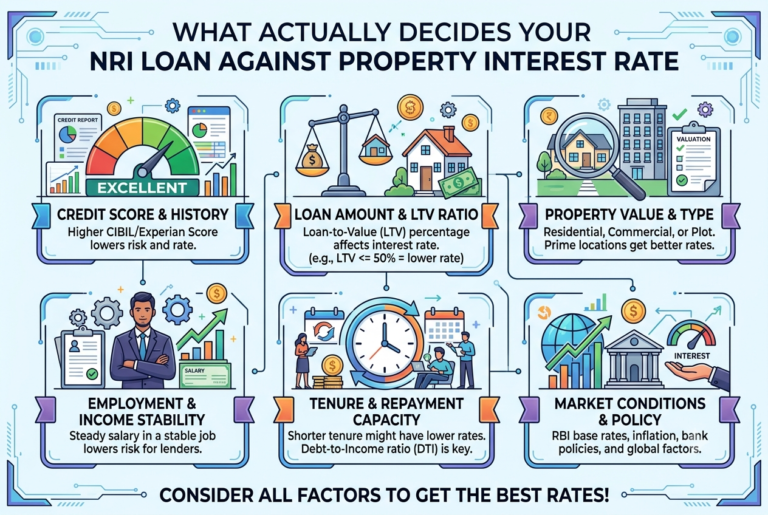
What actually moves your rate
A few things genuinely affect what you’re offered, and NRIs have some control over most of
them.
• Your credit profile. A strong credit history, in India and in your country of residence,
usually pulls your rate toward the lower end of the range.
• The property’s documentation. A clean title with complete municipal approvals
and no pending disputes gets easier, often cheaper financing than a property with
paperwork gaps. This connects to a wider issue many NRIs run into, the legal
challenges around inherited property or multiple legal heirs, which often surface
only once a loan application is underway.
• Loan amount and tenure. Larger loans sometimes come with marginally better
rates. Shorter tenures often carry a small rate advantage, even though the EMI is
higher.
• Property location. Properties in active metro markets are seen as lower risk
collateral than ones in smaller towns with thinner resale demand.
• Your existing banking relationship. If you already hold an NRE or NRO account, or
an existing loan, with a lender, that history can work in your favor.
Fixed or floating: which one costs less?
There’s no single right answer, but a simple way to think about it.
• A fixed rate gives you certainty. Your EMI stays the same even if rates rise elsewhere,
which helps if you want predictable monthly outflow while managing things from
abroad. It’s usually set slightly higher than the starting floating rate to account for
that certainty.
• A floating rate starts lower but moves with the benchmark. You benefit if rates fall,
and pay more if they rise, sometimes without much warning if you’re not tracking it
from another country.
Floating rates tend to suit shorter tenures better, since there’s less time for rate cycles to
swing. For longer tenures, a fixed rate’s predictability can be worth the slightly higher
starting cost.
How this compares to a home loan
It’s easy to assume all property-backed loans are priced similarly. They’re not.
• NRI home loans, meant for purchasing, constructing, or renovating a home, usually
carry lower rates, often in the range of 7% to 8.75% per year, with financing up to
75% to 90% of the property’s value.
• A loan against property starts higher and typically caps at a lower loan-to-value
ratio, since the funds can be used for anything, medical costs, business needs,
education, and lenders view that flexibility as slightly higher risk.
If you’re buying a new property, a home loan will almost always work out cheaper. If you
already own a property and need funds for something else, a loan against property is the
more relevant option, even at a higher rate.
How to get a better rate
A few practical steps make more difference than negotiating alone:
• Get your documentation in order before applying, not during. A clean title often does
more for your rate than back and forth with the bank.
• Compare total cost, not just the headline rate. Processing fees, prepayment
charges, and how the floating benchmark resets can matter as much as the rate
itself.
• Check if your existing banking relationship qualifies you for a preferential rate before
applying elsewhere.
• Plan for Power of Attorney requirements early if you won’t be physically present in
India at disbursal. Most lenders require this and setting it up late is a common
reason application slows down.
• Ask specifically what loan-to-value ratio you’re being offered, since a lower LTV
sometimes comes with a better rate, and it’s worth knowing which tradeoff you’re
making.
A property that’s been properly maintained, with updated municipal records and
documented inspections, is simply easier for a bank to value quickly and confidently.
Upkeep can end up affecting your rate almost as much as your income does.
How Friends of NRI fits into this
Most of what affects an NRI’s loan against property rate has less to do with the loan
application itself, and more to do with everything sitting underneath it, the paperwork, the
property’s condition, and whether someone reliable has been keeping an eye on things.
This is where Friends of NRI usually come in:
• Documentation support: helping verify that a property’s title, approvals, and
records are clean and current before an application is even submitted, so gaps get
caught early rather than mid-process.
• Property upkeep: regular inspections and maintenance that keep a property in a
condition bank can value quickly, without last-minute repairs or disputes surfacing
during the loan process.
• On-ground coordination: managing the practical parts, like Power of Attorney
arrangements or liaising with the lender in India, when you can’t be the one making
that call during Indian business hours.
None of this replaces the bank or guarantees a specific rate. It simply means the
paperwork and the property itself are in the best possible shape by the time you apply,
which tends to matter more than most people expect.
Frequently asked questions
What is the current interest rate for an NRI loan against property in India? Rates
typically start from around 9.5% per year and move upward depending on the applicant’s
profile, the property’s documentation, and the lender’s criteria at the time.
Can NRIs get a loan against property in India? Yes. Most major banks and several NBFCs
offer this to NRIs, usually at 60% to 80% of the property’s market value, with repayment
routed through an NRO account.
Is a fixed or floating rate better for an NRI loan against property? It depends on the
tenure. Floating rates often suit shorter tenures, while fixed rates offer predictability worth a
slightly higher starting cost over longer repayment period.
Does property documentation affect the interest rate offered? Yes. A clean title with
complete approvals usually leads to smoother, sometimes better-priced financing.
Documentation gaps often mean delays or less favorable terms.
Is a Power of Attorney required for loan disbursement? If you won’t be physically present
in India at disbursal, most lenders require a POA to complete the process on your behalf.
What this comes down to
The rate you’re quoted rarely comes down to the property’s value alone. It reflects your
credit profile, the property’s paperwork, your existing banking relationship, and sometimes
simply the timing of your application. Getting your documentation and property in strong
shape before applying tends to matter more than any single negotiating tactic.
Your property in India deserves to be looked after well before a loan application ever comes
into the picture, so that when it does, you’re not scrambling to fix things you didn’t know
needed fixing
What Actually Decides Your NRI Loan Against Property Interest Rate