Buying Property in India as an NRI? Start with the Right Documents
For many Non-Resident Indians (NRIs), owning a home in India is more than an investment;
it is about staying connected to family, planning, or creating a retirement home. While
buying property in India is legally permitted for most NRIs, the process involves
documentation, financial compliance, and legal due diligence that can feel overwhelming
when you are living abroad.
A missing document, an overlooked legal verification, or a misunderstanding of tax
requirements can delay your purchase or even create complications later. Fortunately, with
proper planning and the right guidance, buying property in India can be a smooth and
rewarding experience.
This guide explains the documents you’ll need, how the buying process works, important
tax considerations, and practical tips that help NRIs invest in Indian real estate with
confidence.
Table of Contents
• Can NRIs Buy Property in India?
• Documents Required for NRIs
• How Do NRIs Buy Property in India?
• Tax and Financial Considerations
• Common Challenges NRIs Face
• How Friends of NRI Can Help
• Frequently Asked Questions
• Conclusion
Can NRIs Buy Property in India?
Yes. Under the Foreign Exchange Management Act (FEMA), most NRIs and Overseas
Citizens of India (OCI) cardholders can purchase residential and commercial property in
India without prior approval from the Reserve Bank of India (RBI).
However, there are restrictions on purchasing agricultural land, plantation property, and
farmhouses unless permitted under applicable regulations.
Before investing, always review the latest RBI and FEMA guidelines or consult a qualified
legal professional to ensure compliance.
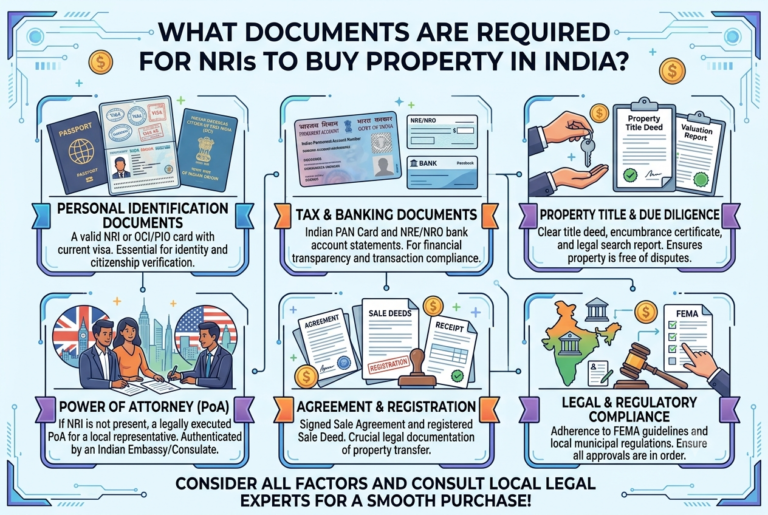
What Documents Are Required for NRIs to Buy Property in India?
Preparing your documents before starting the purchase process can help avoid
unnecessary delays.
1. Valid Passport
Your passport serves as your primary identity proof and confirms your NRI or OCI status.
2. Visa, Residence Permit, or OCI Card
Banks, developers, and legal professionals may require proof of your overseas residential
status.
3. PAN Card
A Permanent Account Number (PAN) is generally required for property transactions, tax
compliance, and financial documentation.
4. Overseas Address Proof
Accepted documents may include:
• Utility bill
• Bank statement
• Driving licence
• Government-issued residence document
5. Passport-Sized Photographs
These are commonly required during KYC verification and property registration.
6. Income Proof (If Applying for a Home Loan)
Banks may request:
• Salary slips
• Employment certificate
• Employment contract
• Overseas bank statements
• Income tax documents, where applicable
7. Property Documents
Never purchase a property without verifying essential legal documents such as:
• Title deed
• Sale agreement
• Encumbrance certificate
• Approved building plan
• Completion or occupancy certificate, where applicable
Independent legal verification helps ensure the property has a clear title and complies with
local regulations.
How Do NRIs Buy Property in India?
Buying property while living abroad has become much easier thanks to digital banking and
online documentation. However, following a structured approach can help prevent costly
mistakes.
Step 1: Plan Your Budget
Consider the property’s purchase price along with stamp duty, registration charges, taxes,
maintenance costs, and financing requirements.
Step 2: Shortlist the Right Property
Research the location, builder’s reputation, connectivity, future development plans, and
resale potential before deciding.
Step 3: Verify the Legal Status
Engage a qualified legal expert to verify ownership, approvals, and title documents before
signing any agreement.
Step 4: Arrange Financing
If you require a home loan, compare lenders based on eligibility, repayment options,
customer support, and overall borrowing experience instead of focusing only on interest
rates.
Step 5: Register the Property
Once documentation and payments are complete, register the property with the relevant
authority to establish legal ownership.
Step 6: Preserve Important Records
Maintain digital and physical copies of agreements, payment receipts, registration
documents, and tax records for future reference.
Is a Tax Receipt Required for an NRI to Purchase a House?
There is no universal requirement for an NRI to submit a separate “tax receipt” before
purchasing a property in India.
However, property transactions may involve compliance with applicable tax laws, including
Tax Deducted at Source (TDS), stamp duty, registration charges, and other statutory
obligations.
Since tax requirements depend on the property’s value and the nature of the transaction, it
is advisable to consult a qualified tax professional before completing the purchase.
Does an NRI Need an Aadhaar Card to Buy Property in India?
No.
An Aadhaar card is not mandatory solely for purchasing property in India.
In most cases, NRIs can complete property transactions using:
• Passport
• PAN card
• OCI card, where applicable
• Overseas address proof
However, certain banks or financial institutions may request Aadhaar for specific banking
services if you already possess one.
How Much Income Is Tax-Free for NRIs in India?
NRIs are taxed differently from resident Indians.
Your tax liability depends on factors such as:
• Your residential status under Indian tax laws
• The source of your income
• The applicable financial year’s tax rules
Generally, income earned outside India is not taxable in India if it does not accrue or arise
in India. However, income generated within India, including rental income or capital gains
from property, may be taxable.
Tax regulations change periodically, so always consult a qualified tax advisor for guidance
specific to your situation.
What Are the Disadvantages of Being an NRI?
While investing in Indian property offers long-term benefits, NRIs often encounter practical
challenges.
Managing Property from Abroad
Regular inspections, maintenance, tenant management, and emergency repairs can be
difficult without a trusted local representative.
Documentation Delays
Obtaining notarised or attested documents from overseas can extend transaction
timelines.
Legal Complexities
Property laws vary across states, making professional legal verification essential before
purchasing.
Communication Challenges
Coordinating with builders, banks, lawyers, and government offices across different time
zones can slow down the buying process.
Risk of Property Fraud
NRIs are often more vulnerable to fraudulent transactions because they cannot physically
monitor the property or verify documents regularly.
These challenges can be managed effectively with proper planning and dependable local
support.
How Friends of NRI Can Help
Buying property is only the beginning of your journey. Managing documentation, legal
coordination, property verification, maintenance, and communication with local
stakeholders often continues long after the purchase.
Friends of NRI supports overseas Indians by providing reliable on-ground assistance that
simplifies these responsibilities. Whether you need help coordinating paperwork,
connecting with trusted legal or property professionals, or managing your property while
living abroad, having dependable local support can save both time and effort.
If you’re planning to own or manage property in India, you may also find these resources
helpful:
• Property Management Services for NRIs
• NRI Services in India
• Legal Challenges NRIs Face in Property Management and Their Solutions
These resources provide valuable guidance for managing property efficiently while
reducing legal and operational challenges.
Frequently Asked Questions
Can NRIs buy property in India without visiting?
Yes. In many cases, property transactions can be completed through a legally valid Power
of Attorney or authorized representative, subject to applicable laws and documentation
requirements.
Is a PAN card mandatory?
A PAN card is generally required for property transactions and tax-related compliance in
India.
Can NRIs purchase agricultural land?
Generally, NRIs cannot freely purchase agricultural land, plantation property, or
farmhouses unless specifically permitted under applicable regulations.
Can NRIs apply for home loans in India?
Yes. Many Indian banks offer home loans to eligible NRIs, subject to their lending policies
and documentation requirements.
Should property documents be legally verified?
Absolutely. Independent legal verification confirms ownership, approvals, and compliance
before you invest, helping reduce the risk of future disputes.
Conclusion
Buying property in India as an NRI can be a rewarding investment when supported by
proper planning and informed decision-making. Preparing the necessary documents,
understanding legal requirements, verifying property records, and staying aware of tax
obligations can help you avoid unnecessary delays and financial risks.
If managing the process from overseas feels overwhelming, reliable on-ground support can
make a significant difference. From documentation and legal coordination to property
management and local assistance, having experienced professionals by your side allows
you to invest with greater confidence while staying focused on your life abroad.