
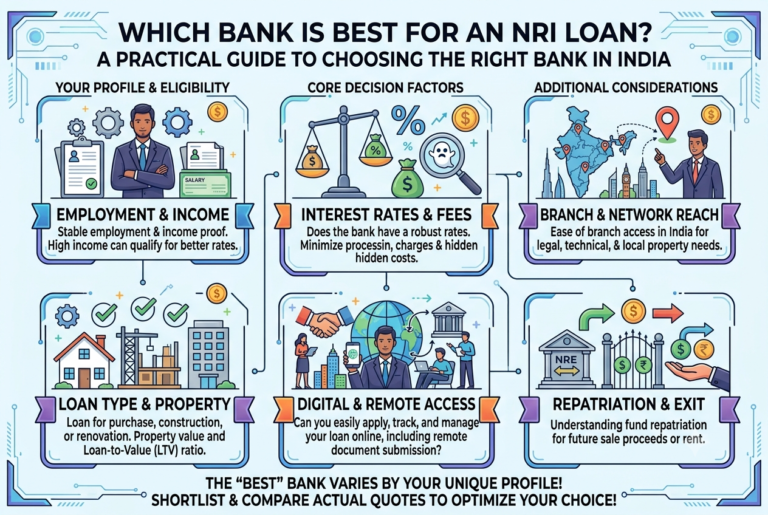
Which Bank Is Best for an NRI Loan? Here’s What You Should Know
Buying a home in India, renovating an inherited property, or arranging funds for your family’s
needs can be challenging when you’re living thousands of miles away. While Indian banks
have made NRI lending more accessible than ever, choosing the right bank is still one of the
biggest decisions you’ll make.
Many people begin by searching, “Which bank is best for an NRI loan?” However, there isn’t
a single bank that’s perfect for everyone. The right lender depends on your country of
residence, income, employment, credit profile, loan purpose, documentation, and even
how comfortable you are managing your finances remotely.
Instead of ranking banks from “best” to “worst,” this guide compares leading lenders based
on different borrowing needs. You’ll also learn what to look for before applying, common
mistakes to avoid, and how on-ground support in India can make your loan journey much
smoother.
Understanding NRI Loans
An NRI loan is a financial product offered by Indian banks to eligible Non-Resident Indians
(NRIs), Overseas Citizens of India (OCIs), and, in some cases, Persons of Indian Origin
(PIOs). These loans are designed to help overseas Indians meet financial needs in India
without having to depend entirely on their savings.
Depending on your goals, you can apply for:
• Home loans
• Personal loans
• Loan against property
• Education loans
• Vehicle loans
• Business loans
Today, many banks offer digital application processes, allowing NRIs to submit documents
online and track applications remotely. However, certain stages- such as property
verification or legal documentation—may still require coordination within India.
Types of Loans Available for NRIs
Home Loans
Home loans are ideal if you’re purchasing, constructing, or renovating residential property
in India. They usually offer longer repayment tenures and are among the most popular loan
products for NRIs.
Personal Loans
Need funds for medical expenses, education, travel, or a family emergency? A personal
loan provides unsecured financing without requiring property as collateral, although
eligibility criteria are generally stricter.
Loan Against Property
If you already own residential or commercial property in India, you may be able to borrow
against its value. This option often provides larger loan amounts than unsecured loans.
Education Loans
Many banks offer education loans for higher studies in India or abroad, subject to their
lending policies and eligibility requirements.
Business Loans
Eligible NRIs investing in businesses or expanding existing ventures in India may also
qualify for business financing through selected banks.
Which Bank Is Best for an NRI Loan?
The better question is:
Which bank is best for your borrowing needs?
A salaried software engineer in Canada purchasing an apartment in Bengaluru has different
requirements from an entrepreneur in Dubai investing in commercial property or an NRI in
the UK renovating an ancestral home.
Rather than focusing only on advertised interest rates, evaluate the complete borrowing
experience.
Compare Banks Based on Your Needs
If You Need… Banks Commonly Considered Why They May Be Suitable
Buying your first home SBI, HDFC Bank, ICICI Bank Strong home loan offerings and dedicated NRI services
A digital-first
experience HDFC Bank, ICICI Bank, Axis Bank Online applications, document uploads, and loan tracking
Loan against property SBI, Bank of Baroda, PNB Established secured lending portfolios
Existing banking
relationship Your current bank Simpler verification and familiarity with your financial profile
International banking
support SBI, ICICI Bank, Bank of Baroda Wider overseas presence and NRI banking services
banking services
Note: Loan products, eligibility criteria, interest rates, and processing charges change over
time. Always verify the latest information directly with the bank before applying.
How to Evaluate an NRI Loan Beyond Interest Rates
Many borrowers choose the lender advertising the lowest interest rate. While rates matter,
they shouldn’t be the only deciding factor.
1. Eligibility Requirements
Banks assess factors such as:
• Country of residence
• Employment status
• Monthly income
• Credit history
• Existing liabilities
• Age
Meeting one bank’s criteria doesn’t automatically qualify you for another.
2. Documentation
Incomplete documentation is one of the most common reasons for delays. Before
applying, check exactly what your lender requires, especially if your documents were
issued outside India.
3. Loan Processing Time
If you’re buying property with payment deadlines, faster processing can be just as valuable
as a lower interest rate.
4. Customer Support
Managing a loan from overseas means you’ll rely heavily on email, phone, and online
banking. Banks with dedicated NRI relationship managers often provide a smoother
experience.
5. Repayment Flexibility
Look beyond the EMI.
Understand:
• Prepayment rules
• Foreclosure charges
• Processing fees
• Repayment tenure
• Online payment options
These details affect the overall cost of borrowing.
Eligibility Criteria for NRI Loans
While eligibility varies by lender, most banks generally look for:
• Valid NRI or OCI status
• Stable overseas employment or business income
• Acceptable age as per lending policy
• Good repayment capacity
• Satisfactory credit profile
• Compliance with KYC requirements
For secured loans, the bank will also assess the property’s legal and technical status
before approval.
Documents Usually Required
Although documentation differs by lender, applicants are commonly asked to provide:
• Passport
• Visa or residence permit
• PAN card
• Overseas address proof
• Passport-size photographs
• Salary slips or employment contract
• Bank statements
• Proof of income
• Property documents (for home loans or loans against property)
Having these documents ready before applying can significantly reduce processing time.
How Friends of NRI Can Simplify the Process
Applying for an NRI loan isn’t always limited to filling out an online form. Banks may request
property verification, additional paperwork, legal documents, or coordination with
builders, lawyers, or local authorities. Managing these tasks from another country can be
time-consuming and stressful.
This is where Friends of NRI adds value.
Friends of NRI is not a bank or a lending institution. Instead, it provides trusted on-ground
support for NRIs managing responsibilities in India. Whether you’re purchasing property,
arranging documentation, coordinating with professionals, or handling family-related
matters, having reliable local assistance can make the process far more efficient.
For many NRIs, financial planning and property management go hand in hand. If you’re
purchasing or maintaining property in India, you may also find these resources helpful:
• Property Management Services for NRIs
• Can NRIs Get a Loan Against Property in India
• NRI Services in India
• Legal Challenges NRIs Face in Property Management and Their Solutions
These resources can help you better understand the responsibilities that often accompany
property ownership and financial decisions in India.
Which Bank Gives a Personal Loan to NRIs?
Personal loans are a preferred financing option for NRIs who need funds without pledging
property as security. They can be used for a variety of purposes, including medical
emergencies, higher education, home renovations, weddings, travel, or other personal
expenses.
Several leading Indian banks offer personal loans to eligible NRIs, including:
• State Bank of India (SBI)
• HDFC Bank
• ICICI Bank
• Axis Bank
• Bank of Baroda
• Punjab National Bank
However, not every NRI will qualify. Banks evaluate several factors before approving an
application, such as:
• Country of residence
• Employment type and stability
• Monthly income
• Existing financial obligations
• Creditworthiness
• Relationship with the bank
Instead of choosing a lender solely because it advertises a lower interest rate, compare the
overall borrowing experience. Processing speed, customer support, repayment flexibility,
and transparency are equally important.
Which Indian Bank Is Best for NRIs?
The answer depends entirely on your financial needs.
If you’re purchasing your first home in India, a bank with strong home loan expertise and
efficient property verification processes may be the right fit. If you manage all your finances
digitally, you may prefer a lender that offers a seamless online application and document
submission process.
Here’s a quick guide:
Your Priority What to Look For
Buying property Strong home loan products and experienced NRI teams
Faster loan processing Digital onboarding and online document verification
Existing customer relationship Easier KYC and potentially smoother processing
Overseas banking support Dedicated NRI banking services & relationship managers
The “best” bank is the one that matches your financial goals, provides responsive support,
and offers clear, transparent loan terms.
Can We Take a Loan from an NRI?
This question often creates confusion because it can mean two different things.
Can an NRI borrow money from an Indian bank?
Yes. Eligible NRIs can apply for various loan products in India, subject to the lending bank’s
eligibility criteria and documentation requirements.
Can an Indian resident borrow directly from an NRI?
Yes, but such arrangements are governed by the Reserve Bank of India (RBI) and other
applicable regulations. The purpose of the loan, repayment terms, and relationship
between the borrower and lender determine whether the transaction is permitted.
Since regulations can change, it’s advisable to consult the respective bank or a qualified
financial or legal advisor before entering into such arrangements.
What Is the EMI for a ₹20 Lakh Personal Loan?
The monthly EMI depends on four key factors:
• Loan amount
• Interest rate
• Loan tenure
• The lender’s terms
Common Mistakes NRIs Make While Applying for Loans
Applying for a loan from overseas comes with its own set of challenges. Avoiding these
common mistakes can improve your chances of a smoother approval process.
Common Mistakes NRIs Make While Applying for Loans
Applying for a loan from overseas comes with its own set of challenges. Avoiding these
common mistakes can improve your chances of a smoother approval process.
Choosing a Bank Based Only on Interest Rates
A low interest rate may look attractive, but hidden charges, processing fees, and inflexible
repayment terms can increase the overall borrowing cost.
Not Comparing Multiple Loan Offers
Different banks have different lending policies. Comparing lenders helps you identify the
most suitable option based on your financial profile rather than just advertised rates.
Submitting Incomplete Documentation
Missing or outdated documents are one of the biggest reasons for delays. Double-check
your paperwork before applying.
Ignoring Property Verification
If you’re applying for a home loan or a loan against property, ensure that all property
documents are legally verified and updated. Discrepancies can significantly delay
approvals.
Borrowing More Than Necessary
Although banks may approve a higher loan amount, it’s wise to borrow only what you
genuinely need and can comfortably repay.
A few simple steps can strengthen your application:
• Maintain a healthy credit profile.
• Keep all KYC and income documents updated.
• Declare your income accurately.
• Reduce existing debt before applying.
• Compare multiple banks before making a final decision.
• Read the complete loan agreement, including processing fees and
prepayment conditions.
Being well prepared often makes the loan process faster and less
stressful.
Frequently Asked Questions
1. Can NRIs apply for loans online?
Yes. Most major Indian banks allow NRIs to start the application process online. Depending
on the loan type, additional verification or documentation may still be required.
2. Do all Indian banks offer NRI loans?
No. While many banks have dedicated NRI banking services, the types of loans available,
eligibility criteria, and supported countries vary from one lender to another.
3. Is a resident Indian co-applicant mandatory?
Not always. Some lenders require a resident Indian co-applicant for specific loan products,
while others assess applications on an individual basis.
4. Can NRIs repay loans from abroad?
Yes. Loan repayments are generally made through permitted banking channels such as
NRE or NRO accounts, subject to the bank’s policies and applicable regulations.
5. How long does loan approval take?
Approval timelines vary depending on the lender, loan type, documentation, property
verification, and the applicant’s financial profile.
6. Can NRIs get a loan against property in India?
Yes. Eligible NRIs can apply for a loan against residential or commercial property in India,
provided they meet the bank’s lending criteria and the property satisfies legal and valuation
requirements.
Key Takeaways
• There is no single “best” bank for every NRI.
• Compare lenders based on your financial goals- not just interest rates.
• Documentation and eligibility vary between banks.
• Strong customer support and digital banking can significantly improve the borrowing
experience.
• Preparing your documents in advance helps reduce processing delays.
• If your loan involves property in India, having reliable local support can simplify
documentation and coordination.
Conclusion
Choosing an NRI loan is about much more than finding the lowest interest rate. The right
lender should align with your financial goals, repayment capacity, documentation
readiness, and preferred banking experience.
Take time to compare multiple banks, understand the complete cost of borrowing, and
review all loan terms before deciding. A well-informed choice today can save you time,
money, and unnecessary complications in the future. Whether you’re planning an
investment or managing family commitments, having reliable assistance in India allows
you to focus on your life abroad with greater confidence.