
Blogs

NRI property management checklist
Blogs

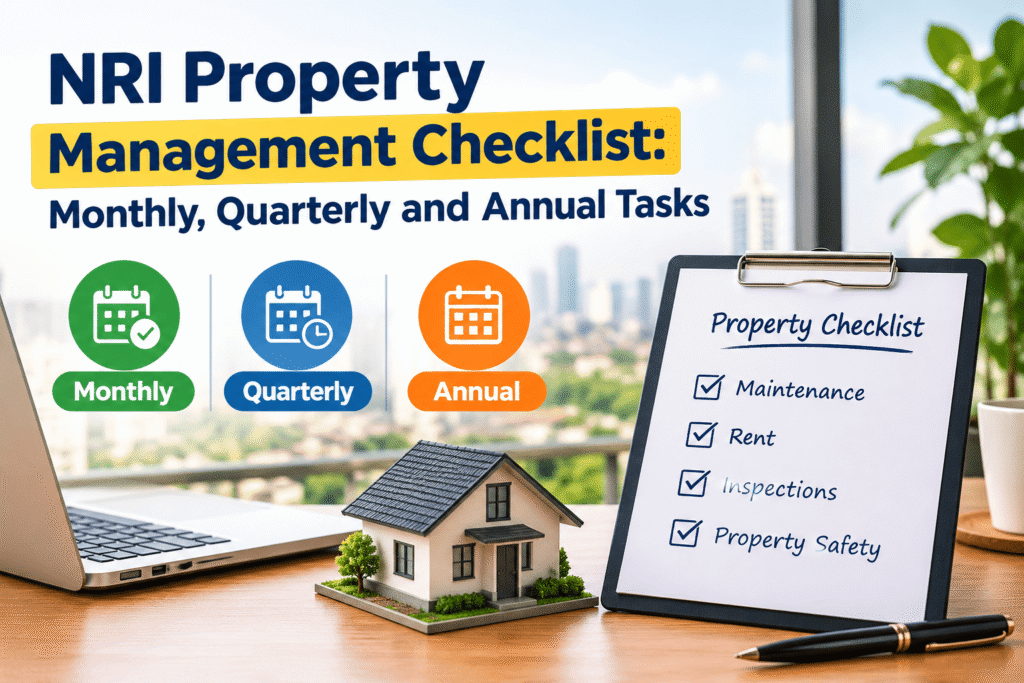
NRI Property Management Checklist: Monthly, Quarterly and Annual Tasks

For an NRI, owning a property in India is often easier than managing it from another country. The property may be a family home, an apartment bought as an investment, a rented house or a property kept for the future. Whatever its purpose, it still needs regular attention. A leaking tap does not wait for your next trip to India. Neither does seepage, a tenant’s complaint, an unpaid maintenance bill or an electrical problem. And when you are living thousands of kilometres away, even a small issue can turn into a long chain of phone calls. This is why having a simple NRI property management checklist can make a big difference. Instead of thinking about property maintenance only when something goes wrong, divide the work into three categories: monthly, quarterly and annual tasks. A clear routine helps you know what needs to be checked, when it needs to be checked and who is responsible for handling it. For NRIs who cannot regularly visit their property, professional Property Management Services in India can also provide the local support needed to keep these tasks on track. Why NRIs Need a Property Management Checklist When you live in India, property management often happens naturally. You notice a dripping tap. You see that the paint is getting damaged. The society sends a notice. A tenant calls you. You can visit the property if something needs to be checked. Living abroad changes that. Your property may be sitting in another city while you are working in London, Dubai, Toronto, Singapore or Sydney. You may hear about a problem only after it has already become serious. A checklist changes the approach from: “Something is wrong. What do I do now?” to: “This was scheduled to be checked, and we already know its condition.” That small difference can make remote property ownership much easier. Monthly NRI Property Management Checklist Monthly tasks are mostly about staying informed. They don’t necessarily require major maintenance. The purpose is to make sure nothing important is being missed. Check the Property If the property is vacant, arrange a physical visit. The inspection should look for obvious signs of: Water leakage Dampness Pest activity Electrical issues Damage to doors or windows Unusual smells Security concerns General cleanliness For a rented property, check whether the tenant has reported any maintenance issue. If you cannot visit yourself, ask the person handling the property to share photographs or videos. Check Rent and Property Expenses If the property is rented, confirm that the expected rent has been received. Also keep track of regular expenses such as: Society maintenance Electricity Water Property-related services Repairs Other recurring charges A monthly statement can make this much easier for an NRI owner to review. You don’t need a complicated system. You simply need to know what came in, what went out and why. Speak to the Tenant If someone is living in your property, don’t wait until there is a major complaint before communicating. A simple monthly check-in can help identify small issues early. For example, a tenant may mention that the bathroom tap has started leaking or the air conditioner isn’t working properly. These are easier to deal with when addressed early. Check Society or Building Updates Apartment owners should also stay aware of communication from the housing society or building management. There could be information about: Maintenance work Building repairs Parking Security Access Water supply Other society-related matters An NRI may miss these updates simply because they are not physically present. Having a local representative or property manager monitor them can help. Quarterly NRI Property Management Checklist Monthly checks keep you informed. Quarterly checks should go a little deeper. Think of these as a more detailed health check for your property. Conduct a Detailed Property Inspection Every few months, arrange a proper inspection rather than relying only on tenant feedback or occasional photographs. Check the: Kitchen Look at taps, drainage, cabinets, appliances and signs of leakage. Bathrooms Check water fittings, drainage, seepage and ventilation. Bedrooms and Living Areas Look for dampness, damaged walls, furniture issues and electrical problems. Balcony and Exterior Areas Check drainage, cracks, water accumulation and general condition. Doors and Windows Check locks, handles, hinges and visible damage. A property inspection is particularly important when the house remains vacant. Review Completed Repairs If repairs were carried out during the previous few months, review them. Ask: What was repaired? Who completed the work? What did it cost? Was the problem actually resolved? Is there any warranty or service period? Are photographs available? Keeping this information together makes it much easier to manage your property from abroad. Review Tenant-Related Issues For rented properties, quarterly reviews are a good opportunity to look at the bigger picture. Is the tenant raising repeated maintenance complaints? Are payments being received as expected? Is the property being maintained properly? Are there any changes that need attention? The aim isn’t to interfere unnecessarily with the tenant. It is simply to make sure the property remains in good condition. Review Property Documents Keep important property documents organised digitally. Depending on the property and your circumstances, these may include: Sale deed Registration documents Tax records Society documents Rental agreement Maintenance records Repair invoices Insurance documents Utility records For an NRI, having digital access to these documents can save considerable time when something needs to be checked from abroad. Annual NRI Property Management Checklist Annual tasks are about stepping back and looking at the property as a whole. Instead of asking, “Is there any problem today?” ask: “How has the property performed over the last year?” Review the Overall Condition Look at the property from top to bottom. Does it need painting? Are appliances becoming old? Are there recurring plumbing problems? Does the property need professional cleaning? Are there signs of long-term dampness or deterioration? Small repairs that keep repeating may indicate that a larger solution is needed. Review Rental Performance If your property is rented, review the year’s numbers. Look at: Total rent received Vacancy periods
NRI property maintenance
Blogs, NRI Property Management

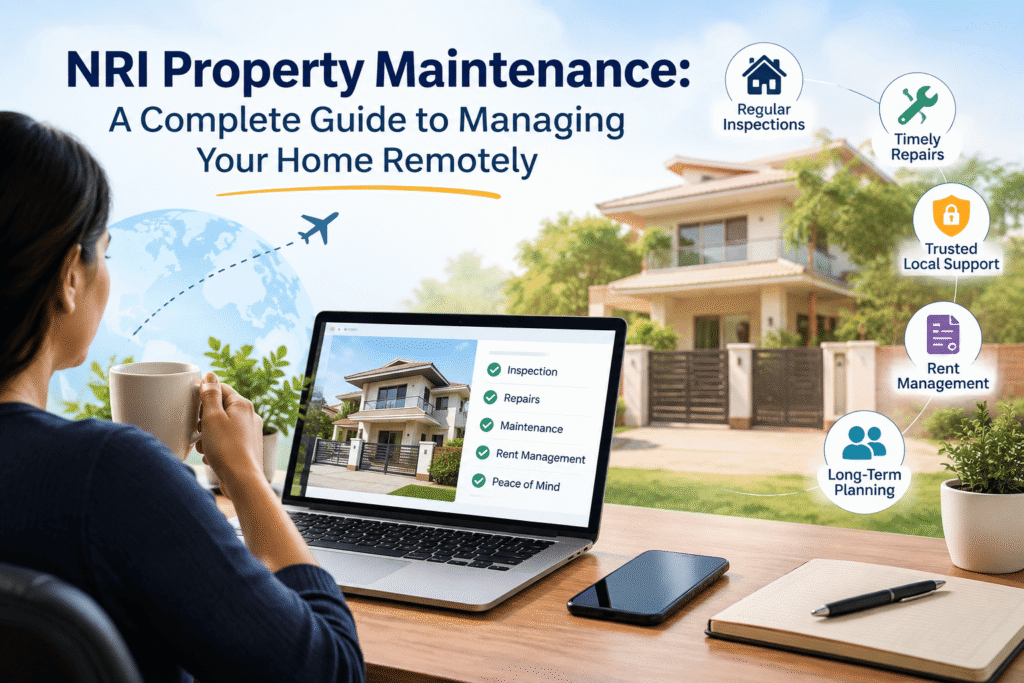
NRI Property Maintenance: A Complete Guide to Managing Your Home Remotely

Living abroad can give you opportunities, a career and a different life. But when your home, parents or other responsibilities are still in India, distance can sometimes make simple things surprisingly difficult. A leaking tap. A tenant who has stopped responding. A house that has been locked for months. A repair that needs someone to visit the property. Your parents needing a doctor’s appointment while you are sitting in another time zone. None of these problems are unusual. The difficult part is being there when they happen. For many NRIs, managing life in India is not about one big problem. It is about dozens of small things that need attention at the right time. This is where NRI Services in India can make a real difference. Friends of NRI helps bridge that distance by providing local support for NRIs who need someone dependable to coordinate property, maintenance, elderly care, medical requirements and other day-to-day needs in India. Your Property Doesn’t Stop Needing Attention When You Leave India Buying a home in India is often an emotional decision for an NRI. It may be the family home where you grew up. It may be a property bought for your parents. It may be an investment for the future. Or perhaps it is the home you plan to return to one day. Whatever the reason, the property still needs attention. The problem starts when nobody is regularly checking it. A small seepage can turn into damaged walls. A faulty appliance can become a bigger repair. A vacant property can collect dust, develop pest problems or simply deteriorate because nobody is checking it. If there is a tenant, there are different concerns—rent, maintenance requests, repairs, inspections, documentation and handover. When you are abroad, even a simple repair can become a long chain of phone calls. Someone needs to visit the property. Someone needs to understand the problem. Someone needs to find a reliable technician. Someone needs to check the work. And someone needs to keep you updated. That is the real challenge of managing property remotely. Regular Property Checks Can Prevent Bigger Problems One of the simplest things an NRI can do is make property inspection a routine rather than an emergency activity. You don’t necessarily need someone visiting every day. But the property should not remain completely unchecked for long periods either. A proper inspection can cover things such as: Plumbing and water leakage Electrical fittings Doors, windows and locks Dampness and seepage Pest activity Appliances Air-conditioning General cleanliness Furniture and fittings Security concerns The important thing is what happens after the inspection. A useful update should tell you what was found, what needs attention, what can wait and what the estimated cost may be. For an NRI sitting overseas, photographs and videos can make these updates much easier to understand. Instead of hearing, “There is some leakage,” you can actually see where the leakage is and decide what you want to do. Don’t Make Your Parents Your Property Manager This is something many NRIs do without realising it. Their parents live in the same city, so whenever something needs to be repaired, they are asked to handle it. At first, it may seem convenient. But over time, the list grows. “Please meet the plumber.” “Please collect the documents.” “Please check the flat.” “Please speak to the tenant.” “Please go to the society office.” For elderly parents, these responsibilities can become tiring. And sometimes the situation is the other way around. The NRI is already worried about their parents, while also trying to manage a property from another country. This is one reason professional Elderly Care Services in India and property support can become valuable for families living abroad. The goal is not to replace family. It is to make sure family members don’t have to carry every responsibility themselves. Looking After Parents Is About More Than Medical Emergencies When people hear “elderly care”, they often think only about illness or hospital visits. But real life is usually much simpler. It can be helping an elderly parent get to a doctor’s appointment. It can be arranging a medical test. It can be making sure medicines are available. It can be checking whether they are doing okay after a hospital visit. Sometimes, it is simply having someone nearby who can visit them when their children cannot. For an NRI, this can provide something that phone calls cannot: a physical presence in India. Recent reporting on elder care in India also highlights how families living abroad increasingly look for support that goes beyond medical care, including companionship, home visits, daily assistance and coordination with healthcare providers. Medical Support When You Are Miles Away Imagine your mother has a routine medical appointment. You can book the appointment from abroad. But who will accompany her? Who will arrange transport? Who will help her reach the hospital? Who will collect the reports? Who will explain what needs to happen next? Of course, every family situation is different, and medical decisions should always remain with the patient and qualified healthcare professionals. But the practical coordination around healthcare can still be difficult for families living abroad. This is where medical support for NRIs can be useful. Friends of NRI can help coordinate relevant local requirements so that an NRI does not have to manage every small logistical detail from another country. Property and Parents Are Often Connected For many NRIs, property and elderly care are not two separate subjects. They are connected. The house may belong to the parents. The parents may be living in the property. The NRI may be paying for repairs and household expenses. The same person may need to coordinate the plumber, electrician, doctor, driver and other local requirements. This is why an NRI often needs more than a property manager. They need one dependable local support system. Someone who understands that the house is not just an asset. It is somebody’s home. What Does a Good NRI Support Service Actually Do? The answer

property maintenance for NRIs in India
Blogs

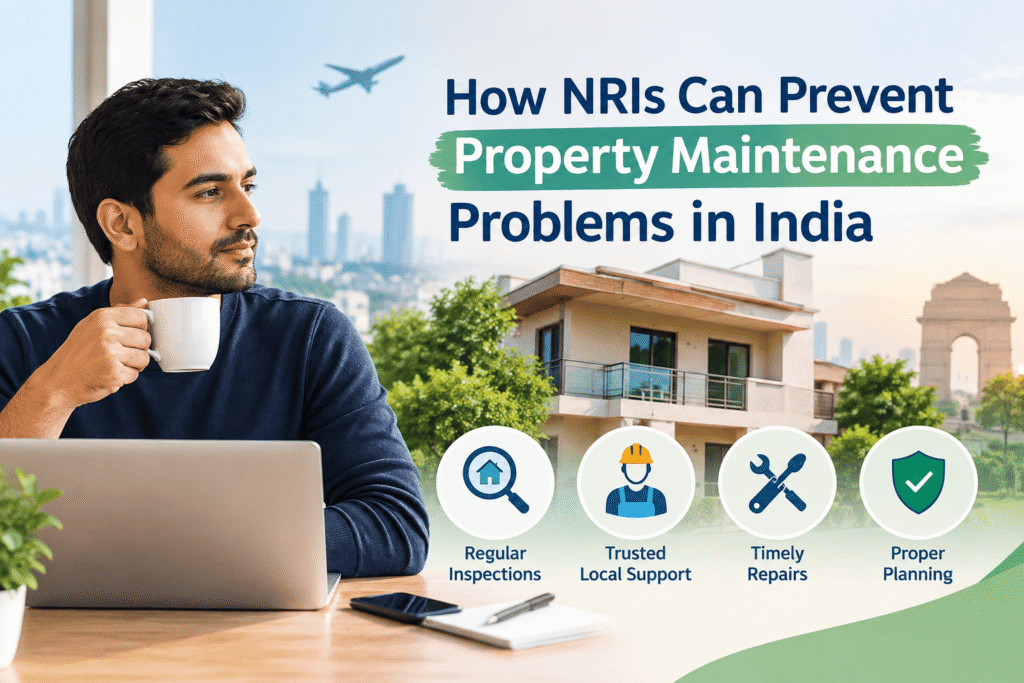
How NRIs Can Prevent Property Maintenance Problems in India

You leave India, but your property stays behind. And while you may be living in Dubai, London, Toronto, Singapore or New York, a leaking tap in your Delhi flat does not wait for you to come back. Neither does a power issue, seepage, termite problem or a tenant calling about a broken appliance. For an NRI, owning a property in India can become difficult for one simple reason: you cannot be physically present when something goes wrong. The problem is rarely the repair itself. The bigger problem is finding out about it on time, finding someone trustworthy to fix it, checking whether the work was actually done properly and keeping track of the expense—all while sitting thousands of kilometres away. That is why property maintenance needs to be planned before there is a problem. With the right system and reliable local support, NRIs can keep their homes, apartments and investment properties in good condition without constantly worrying about what is happening on the ground. Why Property Problems Become Bigger When You Live Abroad A small issue in a property can remain invisible for weeks when nobody is regularly checking it. Take a simple water leak. If you are living in the same city, you might notice dampness on a wall or a dripping pipe and call a plumber the same day. But if your property is locked and you are living overseas, that same leak could continue unnoticed. By the time someone visits, the damage may have already spread to the wall, flooring, furniture or electrical fittings. The same applies to many other problems: A faulty electrical connection A blocked drain Termite activity Dampness and seepage A damaged door or window An air conditioner that needs servicing A broken water pump A property that has not been cleaned for months For an NRI, early detection is often the biggest part of property maintenance. Don’t Wait for Something to Break One of the biggest mistakes property owners make is treating maintenance as a repair activity. Maintenance should start before the repair is needed. A property that is regularly inspected gives you a chance to spot small problems while they are still manageable. For example, during a routine visit, someone might notice a damp patch near the bathroom. That could be investigated immediately instead of waiting until the paint starts peeling or the wall develops serious damage. The same inspection can reveal loose electrical switches, leaking taps, pest activity, damaged furniture or signs that the property has not been properly maintained. For NRIs, a simple inspection can save a lot of unnecessary stress later. What Should Be Checked During a Property Inspection? A proper inspection doesn’t mean someone simply walks into the house and says, “Everything looks fine.” There should be a basic checklist. Plumbing Check taps, bathroom fittings, drainage, pipes, water pressure and visible signs of leakage. Electrical Look for damaged switches, loose connections, faulty appliances and other visible electrical issues. Walls and Ceilings Check for dampness, cracks, water stains, peeling paint and seepage. Doors and Windows Make sure locks, handles, hinges and windows are working properly. Kitchen and Appliances If the property is furnished, appliances should be checked periodically rather than left unused for long periods. Pest Activity Look for termites, cockroaches, rodents and other signs of infestation. General Condition Dust, moisture, bad odour, damaged furniture and poor ventilation can all indicate that a vacant property needs attention. The important part is not just checking these things. The owner should know what was found and what needs to be done. Photos Can Make Remote Management Much Easier When you are in another country, a photograph can tell you more than a long phone conversation. If a maintenance team finds seepage in a bathroom, send a photograph. If a wall needs repainting, show the damaged area. If an appliance has stopped working, share a video if necessary. This gives the NRI owner a clearer picture of the situation before approving the work. It also creates a useful record of the property’s condition over time. For bigger repairs, it is worth keeping photographs from before and after the work. Keep Your Property Maintenance Records Organised Property-related paperwork tends to accumulate. Repair bills. Society notices. Appliance warranties. Service invoices. Electricity bills. Tenant communications. Maintenance receipts. When all of this is sitting in different WhatsApp chats, emails and drawers, finding something later becomes unnecessarily difficult. A simple digital record can make things much easier. Keep track of: What repair was carried out When it was done Who handled it How much it cost What was replaced Any warranty or service information Photographs of the completed work This becomes particularly useful when you own more than one property. Be Careful About Relying Only on Relatives Many NRIs naturally turn to parents, siblings, friends or neighbours for help. And sometimes that works perfectly well. But property maintenance can slowly become an additional responsibility for someone who already has their own work and family commitments. A relative may agree to check the house, but what happens when there is a plumbing emergency while they are travelling? Or when three different vendors need to visit the property? This is where professional NRI Services in India can be useful. The idea isn’t to remove family members from the picture. It is simply to have a dependable local point of contact who can handle routine property-related work when you cannot be there yourself. Choose Vendors Carefully Finding a plumber or electrician is easy. Finding someone you can trust with your property when you are living abroad is a different matter. Before approving a repair, ask for the details: What is the problem? What needs to be repaired? How much will it cost? What material or replacement part is required? When can the work be completed? For expensive repairs, getting more than one estimate can also help you understand whether the quoted cost is reasonable. And once the work is finished, ask for photographs, invoices or other confirmation. That small

NRI investment property in India
Blogs, NRI Property & Real Estate

Buying an Investment Property in India as an NRI: What to Check Before You Invest

Buying property in India while living abroad can look simple on paper. You find a property. You like the location. The numbers look attractive. The builder gives you a payment schedule. You make the investment. But for an NRI, buying a property in India is rarely just about finding the right apartment or plot. There are documents to verify, rules to understand, money to transfer, taxes to consider and, perhaps most importantly, someone has to look after the property once the purchase is complete. That last part is often overlooked. You may buy a beautiful apartment in India while living in Dubai, London, Toronto or Singapore. But who will inspect it when you are away? Who will deal with a maintenance issue? Who will coordinate with a tenant? Who will be there if something needs immediate attention? This is why Property Management Services in India should be considered as part of the investment plan—not only after you have bought the property. First, Understand What You Can Buy Before looking at locations or comparing builders, understand the basic rules that apply to NRIs. Under FEMA rules, an NRI can generally purchase immovable property in India, except agricultural land, plantation property and a farmhouse, subject to the applicable regulations. Payment for eligible purchases can generally be made through permitted banking channels, including inward remittance or eligible NRE, NRO or FCNR(B) accounts. That doesn’t mean every property transaction is identical. Your citizenship, residential status, type of property, source of funds and intended use can affect the transaction. If you are unsure about your eligibility or the structure of a purchase, speak to a qualified legal or tax professional before making a commitment. Don’t Buy the Property Before Checking the Property A good location and attractive interiors don’t tell you whether the property is actually a good purchase. Before paying a substantial amount, look beyond the brochure. Check the property’s ownership history and title documents. Verify whether there are existing claims, loans, disputes or other encumbrances. For a new project, look at the developer’s track record and the project’s applicable registrations and approvals. For a resale property, the checks become even more important. You should also understand: Who legally owns the property? Are the title documents in order? Are applicable property taxes paid? Are society or maintenance dues outstanding? Are there existing loans or charges? Are required approvals available? Does the actual property match the documents? An NRI living abroad should be especially careful here because visiting India repeatedly to resolve a documentation problem can be difficult. Location Matters More Than the Showroom Developers are good at showing you what a property could look like. Your job is to understand what life around that property will actually be like. Visit—or have someone you trust visit—the neighbourhood. Look at the surrounding roads, public transport, schools, hospitals, markets and basic infrastructure. Also ask a less glamorous but very important question: What happens to this property when you are not in India? A property in a convenient location is generally easier to inspect, maintain, rent and manage than one that is difficult to access. For an NRI investor, that practical difference matters. Think About the Property’s Purpose Before Buying Why are you buying? That question should come before the question of which property you like. You may be buying for: Rental income: Then tenant demand, connectivity and the local rental market matter. Long-term investment: Then location, development plans and the property’s overall suitability for your investment horizon become important. A future home: Then your priorities may be different. Community, healthcare, accessibility and proximity to family may matter more than rental yield. Parents or family: Then convenience, safety and access to hospitals and everyday facilities become particularly important. A property that is excellent for one purpose may not make sense for another. Calculate the Cost Beyond the Property Price The price quoted by the seller is only one part of your investment. There may also be costs related to registration, stamp duty, taxes, brokerage, legal verification, maintenance, furnishing, repairs and property management. If you are buying a property that will be rented out, also consider periods when it may remain vacant and the cost of maintaining it between tenants. This is where many first-time investors make a mistake. They calculate the purchase price and expected rent—but forget the costs of actually owning the property. Before investing, create a realistic ownership budget. Understand the Tax Side Before You Sign Tax treatment can become complicated for NRIs, particularly when a property is rented out or eventually sold. For 2026, India’s tax framework has also transitioned to the Income Tax Act, 2025 for relevant transactions from 1 April 2026. The Income Tax Department says TDS provisions previously spread across several sections have been reorganised under Section 393 of the new Act. If you are buying, renting or eventually selling property, don’t rely on an old blog or a friend’s experience from several years ago. Tax rules can depend on the nature of the transaction, the parties involved, the amount and the timing. Get advice from a qualified tax professional for your specific situation. Think About What Happens After You Buy This is where the conversation usually changes. Before buying, everyone is focused on the property. After buying, the questions begin. Who will collect the keys? Who will inspect the apartment? Who will handle repairs? Who will speak to the society? Who will meet a tenant? Who will supervise painting or plumbing work? Who will check the property if it stays vacant for six months? For someone living in India, these may be small tasks. For an NRI, each one can involve multiple calls, emails and time-zone problems. This is where professional Property Management Services in India can become useful. Why Property Management Matters for NRI Investors Buying an investment property is only the beginning. A property has to be maintained if you want to protect its condition and make ownership easier over the long term. Regular inspections can help identify

Blogs

Which Bank Is Best for an NRI Loan? A Practical Guide to Choosing the Right Bank in India

Which Bank Is Best for an NRI Loan? Here’s What You Should Know Buying a home in India, renovating an inherited property, or arranging funds for your family’s needs can be challenging when you’re living thousands of miles away. While Indian banks have made NRI lending more accessible than ever, choosing the right bank is still one of the biggest decisions you’ll make. Many people begin by searching, “Which bank is best for an NRI loan?” However, there isn’t a single bank that’s perfect for everyone. The right lender depends on your country of residence, income, employment, credit profile, loan purpose, documentation, and even how comfortable you are managing your finances remotely. Instead of ranking banks from “best” to “worst,” this guide compares leading lenders based on different borrowing needs. You’ll also learn what to look for before applying, common mistakes to avoid, and how on-ground support in India can make your loan journey much smoother. Understanding NRI Loans An NRI loan is a financial product offered by Indian banks to eligible Non-Resident Indians (NRIs), Overseas Citizens of India (OCIs), and, in some cases, Persons of Indian Origin (PIOs). These loans are designed to help overseas Indians meet financial needs in India without having to depend entirely on their savings. Depending on your goals, you can apply for: • Home loans • Personal loans • Loan against property • Education loans • Vehicle loans • Business loans Today, many banks offer digital application processes, allowing NRIs to submit documents online and track applications remotely. However, certain stages- such as property verification or legal documentation—may still require coordination within India. Types of Loans Available for NRIs Home Loans Home loans are ideal if you’re purchasing, constructing, or renovating residential property in India. They usually offer longer repayment tenures and are among the most popular loan products for NRIs. Personal Loans Need funds for medical expenses, education, travel, or a family emergency? A personal loan provides unsecured financing without requiring property as collateral, although eligibility criteria are generally stricter. Loan Against Property If you already own residential or commercial property in India, you may be able to borrow against its value. This option often provides larger loan amounts than unsecured loans. Education Loans Many banks offer education loans for higher studies in India or abroad, subject to their lending policies and eligibility requirements. Business Loans Eligible NRIs investing in businesses or expanding existing ventures in India may also qualify for business financing through selected banks. Which Bank Is Best for an NRI Loan? The better question is: Which bank is best for your borrowing needs? A salaried software engineer in Canada purchasing an apartment in Bengaluru has different requirements from an entrepreneur in Dubai investing in commercial property or an NRI in the UK renovating an ancestral home. Rather than focusing only on advertised interest rates, evaluate the complete borrowing experience. Compare Banks Based on Your Needs If You Need…                     Banks Commonly  Considered                Why They May Be Suitable Buying your first home        SBI, HDFC Bank, ICICI Bank                 Strong home loan offerings and dedicated NRI services A digital-first experience                              HDFC Bank, ICICI Bank, Axis Bank      Online applications, document uploads, and loan tracking Loan against property           SBI, Bank of Baroda, PNB                      Established secured lending portfolios Existing banking relationship                          Your current bank                                      Simpler verification and familiarity with your financial profile International banking support                                SBI, ICICI Bank, Bank of Baroda             Wider overseas presence and NRI banking services banking services Note: Loan products, eligibility criteria, interest rates, and processing charges change over time. Always verify the latest information directly with the bank before applying. How to Evaluate an NRI Loan Beyond Interest Rates Many borrowers choose the lender advertising the lowest interest rate. While rates matter, they shouldn’t be the only deciding factor. 1. Eligibility Requirements Banks assess factors such as: • Country of residence • Employment status • Monthly income • Credit history • Existing liabilities • Age Meeting one bank’s criteria doesn’t automatically qualify you for another. 2. Documentation Incomplete documentation is one of the most common reasons for delays. Before applying, check exactly what your lender requires, especially if your documents were issued outside India. 3. Loan Processing Time If you’re buying property with payment deadlines, faster processing can be just as valuable as a lower interest rate. 4. Customer Support Managing a loan from overseas means you’ll rely heavily on email, phone, and online banking. Banks with dedicated NRI relationship managers often provide a smoother experience. 5. Repayment Flexibility Look beyond the EMI. Understand: • Prepayment rules • Foreclosure charges • Processing fees • Repayment tenure • Online payment options These details affect the overall cost of borrowing. Eligibility Criteria for NRI Loans While eligibility varies by lender, most banks generally look for: • Valid NRI or OCI status • Stable overseas employment or business income • Acceptable age as per lending policy • Good repayment capacity • Satisfactory credit profile • Compliance with KYC requirements For secured loans, the bank will also assess the property’s legal and technical status before approval. Documents Usually Required Although documentation differs by lender, applicants are commonly asked to provide: • Passport • Visa or residence permit • PAN card • Overseas address proof • Passport-size photographs • Salary slips or employment contract • Bank statements • Proof of income • Property documents (for home loans or loans against property)

Blogs

What Documents Are Required for NRIs to Buy Property in India? A Complete Guide

Buying Property in India as an NRI? Start with the Right Documents For many Non-Resident Indians (NRIs), owning a home in India is more than an investment; it is about staying connected to family, planning, or creating a retirement home. While buying property in India is legally permitted for most NRIs, the process involves documentation, financial compliance, and legal due diligence that can feel overwhelming when you are living abroad. A missing document, an overlooked legal verification, or a misunderstanding of tax requirements can delay your purchase or even create complications later. Fortunately, with proper planning and the right guidance, buying property in India can be a smooth and rewarding experience. This guide explains the documents you’ll need, how the buying process works, important tax considerations, and practical tips that help NRIs invest in Indian real estate with confidence. Table of Contents • Can NRIs Buy Property in India? • Documents Required for NRIs • How Do NRIs Buy Property in India? • Tax and Financial Considerations • Common Challenges NRIs Face • How Friends of NRI Can Help • Frequently Asked Questions • Conclusion Can NRIs Buy Property in India? Yes. Under the Foreign Exchange Management Act (FEMA), most NRIs and Overseas Citizens of India (OCI) cardholders can purchase residential and commercial property in India without prior approval from the Reserve Bank of India (RBI). However, there are restrictions on purchasing agricultural land, plantation property, and farmhouses unless permitted under applicable regulations. Before investing, always review the latest RBI and FEMA guidelines or consult a qualified legal professional to ensure compliance. What Documents Are Required for NRIs to Buy Property in India? Preparing your documents before starting the purchase process can help avoid unnecessary delays. 1. Valid Passport Your passport serves as your primary identity proof and confirms your NRI or OCI status. 2. Visa, Residence Permit, or OCI Card Banks, developers, and legal professionals may require proof of your overseas residential status. 3. PAN Card A Permanent Account Number (PAN) is generally required for property transactions, tax compliance, and financial documentation. 4. Overseas Address Proof Accepted documents may include: • Utility bill • Bank statement • Driving licence • Government-issued residence document 5. Passport-Sized Photographs These are commonly required during KYC verification and property registration. 6. Income Proof (If Applying for a Home Loan) Banks may request: • Salary slips • Employment certificate • Employment contract • Overseas bank statements • Income tax documents, where applicable 7. Property Documents Never purchase a property without verifying essential legal documents such as: • Title deed • Sale agreement • Encumbrance certificate • Approved building plan • Completion or occupancy certificate, where applicable Independent legal verification helps ensure the property has a clear title and complies with local regulations. How Do NRIs Buy Property in India? Buying property while living abroad has become much easier thanks to digital banking and online documentation. However, following a structured approach can help prevent costly mistakes. Step 1: Plan Your Budget Consider the property’s purchase price along with stamp duty, registration charges, taxes, maintenance costs, and financing requirements. Step 2: Shortlist the Right Property Research the location, builder’s reputation, connectivity, future development plans, and resale potential before deciding. Step 3: Verify the Legal Status Engage a qualified legal expert to verify ownership, approvals, and title documents before signing any agreement. Step 4: Arrange Financing If you require a home loan, compare lenders based on eligibility, repayment options, customer support, and overall borrowing experience instead of focusing only on interest rates. Step 5: Register the Property Once documentation and payments are complete, register the property with the relevant authority to establish legal ownership. Step 6: Preserve Important Records Maintain digital and physical copies of agreements, payment receipts, registration documents, and tax records for future reference. Is a Tax Receipt Required for an NRI to Purchase a House? There is no universal requirement for an NRI to submit a separate “tax receipt” before purchasing a property in India. However, property transactions may involve compliance with applicable tax laws, including Tax Deducted at Source (TDS), stamp duty, registration charges, and other statutory obligations. Since tax requirements depend on the property’s value and the nature of the transaction, it is advisable to consult a qualified tax professional before completing the purchase. Does an NRI Need an Aadhaar Card to Buy Property in India? No. An Aadhaar card is not mandatory solely for purchasing property in India. In most cases, NRIs can complete property transactions using: • Passport • PAN card • OCI card, where applicable • Overseas address proof However, certain banks or financial institutions may request Aadhaar for specific banking services if you already possess one. How Much Income Is Tax-Free for NRIs in India? NRIs are taxed differently from resident Indians. Your tax liability depends on factors such as: • Your residential status under Indian tax laws • The source of your income • The applicable financial year’s tax rules Generally, income earned outside India is not taxable in India if it does not accrue or arise in India. However, income generated within India, including rental income or capital gains from property, may be taxable. Tax regulations change periodically, so always consult a qualified tax advisor for guidance specific to your situation. What Are the Disadvantages of Being an NRI? While investing in Indian property offers long-term benefits, NRIs often encounter practical challenges. Managing Property from Abroad Regular inspections, maintenance, tenant management, and emergency repairs can be difficult without a trusted local representative. Documentation Delays Obtaining notarised or attested documents from overseas can extend transaction timelines. Legal Complexities Property laws vary across states, making professional legal verification essential before purchasing. Communication Challenges Coordinating with builders, banks, lawyers, and government offices across different time zones can slow down the buying process. Risk of Property Fraud NRIs are often more vulnerable to fraudulent transactions because they cannot physically monitor the property or verify documents regularly. These challenges can be managed effectively with proper planning and dependable local support.

Blogs

What Actually Decides Your NRI Loan Against Property Interest Rate

Ask five NRIs what interest rate they got on a loan against property in India, and you’ll likely hear five different numbers, even if their properties are worth roughly the same. That’s not the lender being inconsistent. The rate depends on more than just the property, and most NRIs only learn this after they’ve already applied. If you’ve been searching for the latest NRI loan against property interest rates, you’ve probably noticed there’s rarely one clean number, just broad ranges. That’s normal. What’s more useful than chasing an exact figure is understanding what pushes a rate up or down, so you know what you’re working with once an offer land. Where rates currently stand • Loans against property rates typically start from around 9.5% per year and move upward depending on the loan amount, the applicant’s profile, and the lender’s own criteria at the time. • For NRIs, the starting point is often slightly higher than for resident borrowers, since lenders price in the added complexity of cross-border verification. • Loan-to-value ratios usually sit between 60% and 80% of the property’s market value, with loans against property typically landing on the lower end. • Both fixed and floating rate options are usually available. • Repayment happens through an NRO account, and loan funds are credited there too. These numbers shift regularly. Benchmark rates move, lenders revise their spreads monthly or quarterly, and “latest” really means whatever is current when you apply, not when you first started researching. What actually moves your rate A few things genuinely affect what you’re offered, and NRIs have some control over most of them. • Your credit profile. A strong credit history, in India and in your country of residence, usually pulls your rate toward the lower end of the range. • The property’s documentation. A clean title with complete municipal approvals and no pending disputes gets easier, often cheaper financing than a property with paperwork gaps. This connects to a wider issue many NRIs run into, the legal challenges around inherited property or multiple legal heirs, which often surface only once a loan application is underway. • Loan amount and tenure. Larger loans sometimes come with marginally better rates. Shorter tenures often carry a small rate advantage, even though the EMI is higher. • Property location. Properties in active metro markets are seen as lower risk collateral than ones in smaller towns with thinner resale demand. • Your existing banking relationship. If you already hold an NRE or NRO account, or an existing loan, with a lender, that history can work in your favor. Fixed or floating: which one costs less? There’s no single right answer, but a simple way to think about it. • A fixed rate gives you certainty. Your EMI stays the same even if rates rise elsewhere, which helps if you want predictable monthly outflow while managing things from abroad. It’s usually set slightly higher than the starting floating rate to account for that certainty. • A floating rate starts lower but moves with the benchmark. You benefit if rates fall, and pay more if they rise, sometimes without much warning if you’re not tracking it from another country. Floating rates tend to suit shorter tenures better, since there’s less time for rate cycles to swing. For longer tenures, a fixed rate’s predictability can be worth the slightly higher starting cost. How this compares to a home loan It’s easy to assume all property-backed loans are priced similarly. They’re not. • NRI home loans, meant for purchasing, constructing, or renovating a home, usually carry lower rates, often in the range of 7% to 8.75% per year, with financing up to 75% to 90% of the property’s value. • A loan against property starts higher and typically caps at a lower loan-to-value ratio, since the funds can be used for anything, medical costs, business needs, education, and lenders view that flexibility as slightly higher risk. If you’re buying a new property, a home loan will almost always work out cheaper. If you already own a property and need funds for something else, a loan against property is the more relevant option, even at a higher rate. How to get a better rate A few practical steps make more difference than negotiating alone: • Get your documentation in order before applying, not during. A clean title often does more for your rate than back and forth with the bank. • Compare total cost, not just the headline rate. Processing fees, prepayment charges, and how the floating benchmark resets can matter as much as the rate itself. • Check if your existing banking relationship qualifies you for a preferential rate before applying elsewhere. • Plan for Power of Attorney requirements early if you won’t be physically present in India at disbursal. Most lenders require this and setting it up late is a common reason application slows down. • Ask specifically what loan-to-value ratio you’re being offered, since a lower LTV sometimes comes with a better rate, and it’s worth knowing which tradeoff you’re making. A property that’s been properly maintained, with updated municipal records and documented inspections, is simply easier for a bank to value quickly and confidently. Upkeep can end up affecting your rate almost as much as your income does. How Friends of NRI fits into this Most of what affects an NRI’s loan against property rate has less to do with the loan application itself, and more to do with everything sitting underneath it, the paperwork, the property’s condition, and whether someone reliable has been keeping an eye on things. This is where Friends of NRI usually come in: • Documentation support: helping verify that a property’s title, approvals, and records are clean and current before an application is even submitted, so gaps get caught early rather than mid-process. • Property upkeep: regular inspections and maintenance that keep a property in a condition bank can value quickly, without last-minute repairs or disputes surfacing during the loan process. • On-ground

Blogs

Your Tenant Just Stopped Paying Rent. Now What?

It’s 11 PM in New Jersey, which means it’s morning in India. Your phone buzzes. It’s the neighbor, not the tenant. “Beta, I haven’t seen anyone at your flat in three weeks. The society office says rent hasn’t been paid since April.” You open your email. Somewhere there, buried under twelve other things, is a rental agreement you signed four years ago on a trip home. You don’t remember what it says. You’re not even sure where the physical copy is. This is the moment most NRIs dread, not because the property is worth so much, but because you’re suddenly negotiating with a stranger, from another continent, with a document you barely remember drafting. A good rental agreement is the difference between a five-minute phone call to your property manager and a six-month legal mess involving a lawyer you’ve never met, in a court you can’t attend, for a case you don’t fully understand. At Friends of NRI, this is a call we’ve been on more times than we can count. Different cities, different tenants, same panic. So, let’s walk through exactly what we tell families in this situation, in plain language, without the legal jargon that makes most articles on this topic harder to read than the agreement itself. Can I make a rental agreement myself? Technically, yes. There’s no law that says you need a lawyer to draft a rental agreement in India. You can write one yourself, print it on stamp paper, get it signed by both parties and two witnesses, and it’s considered a valid contract. But “you can” and “you should” are different things when you’re not the one who’ll be around to sort out a mistake. A rental agreement drafted casually, copied from a template someone forwarded on WhatsApp, often misses the details that protect you. Things like: • What happens if the tenant sublets the property without telling you. • Who pays for repairs beyond normal wear and tears? • The exact notice period for eviction, and what counts as valid notice. • What happens to the security deposit if there’s a dispute over damage? • A clear clause on rent escalation, so you’re not stuck at the same rate for three years while maintenance costs climb. If you’re managing this from abroad, every one of these gaps becomes a problem you must solve long distance, usually while you’re also trying to hold down a job and manage your own life on the other side of the world. This is one of the most common things we get asked to fix at Friends of NRI: not a broken agreement, but a vague one that never accounted for the fact that the owner wouldn’t be around to interpret it. A well-drafted agreement doesn’t just protect the property. It protects your time, your peace of mind, and the sleep you lose worrying about it. Can I create my own tenancy agreement, or should I register for it? Here’s where the confusion usually starts, and it’s worth clearing up properly because it affects how much protection you have. In India, rental agreements for a tenure of 11 months or less don’t legally require registration with the Sub Registrar’s office. This is exactly why most Indian rental agreements are written for 11 months and simply renewed. It saves the parties a trip to the registrar and the associated registration fees. Agreements for a longer tenure, however, are a different story. Under the Registration Act, leases beyond one year generally need to be registered to carry full legal weight. Some states are stricter about this than others. Maharashtra, for instance, mandates registration for rental agreements regardless of tenure, and landlords who skip it can face real penalties. Karnataka, on the other hand, has no practical online registration process, so a properly notarized and stamped agreement is what courts and banks in Bangalore typically accept. The point is that the rules aren’t identical across India. Where your property sits changes what “doing it right” means. This is one of the quiet reasons NRIs get caught off guard: an agreement that was perfectly fine for a flat in Bangalore might not hold up the same way for a property in Pune. It’s also why our team drafts differently depending on the city, not just the tenant. Is a notarized rent agreement valid in court? Yes, but with a condition that matters more than most people realize. A notarized agreement is admissible as evidence in court. The notary’s job is simply to confirm that the people who signed the document are who they say they are, and that the signatures are genuine. That’s it. The notary isn’t checking whether your clauses are fair, whether the rent escalation is legal, or whether the eviction terms will hold up if challenged. A registered agreement carries more legal standing. It’s recorded with the government, harder to dispute, and generally what courts lean on first when there’s a serious disagreement over eviction, unpaid rent, or damage to the property. If your case ever moves beyond a polite conversation, a registered agreement gives you a much stronger footing than a notarized one. So, think about it this way. Notarization is useful and often sufficient for short term, lower stakes tenancies. Registration is what you want when the property matters: when there’s real money at stake, when the tenancy is longer, or when you simply won’t be around handling things if something goes wrong. For most NRIs managing a family home or an investment property from abroad, that second category describes almost every situation, which is why we default to registration unless there’s a good reason not to. Does an NRI have to pay tax on rental income in India? Yes, and this one catch people off guard almost every time. If you own property in India and rent it out, that rental income is taxable in India, regardless of where you live or where you pay tax on your salary. The tenant is legally required

Blogs

Can NRIs Get a Loan Against Property in India?

Ravi found out about his father’s surgery on a Tuesday morning, standing in a Toronto parking lot with his phone pressed to his ear and his car still running. The hospital wanted an advance by Friday. His savings were tied up in a fixed deposit that wouldn’t mature for four more months. And three thousand Kilometers away, sitting empty except for a caretaker who dropped by once a week, was the flat in Chennai his parents had spent twenty years paying off. He didn’t think of it as an asset that morning. He thought of it as a place his mother kept his old cricket trophies. It took his cousin, back in India, to point out the obvious: that flat could be the fastest source of funds he had. This is how most NRIs discover loans against property. Not through research, but through a moment exactly like Ravi’s, when a family emergency makes an unused asset suddenly very relevant. The property, and the question of whose name is on it Ravi’s first instinct was to call his bank’s NRI helpline. His second, smarter instinct was to check the title deed first. The flat was in his father’s name alone. This trips up more families than you’d expect. A property everyone in the family thinks of as “ours” often has one legal owner on paper, and banks lend against paper, not sentiment. If the property is solely in a parent’s name, the parent needs to be the applicant, with you joining as a co-applicant if you want to be part of the loan. If it’s jointly owned, even partially, that opens the door for you to apply directly, though most lenders still want every owner involved through documentation or a Power of Attorney. Across the property files Friends of NRI has reviewed for clients over the years, unclear or outdated ownership records show up more often than any other single reason an application stall. Ravi’s cousin spent an afternoon at the sub-registrar’s office confirming the title before a single form was filled out. That one afternoon probably saved the week. What a bank will actually offer against a property like that Once ownership is sorted, the number that matters is the loan-to-value ratio, and it usually lands somewhere between 50% and 70% of the property’s current market value. A flat with a clean title in a well-documented metro building tends to sit near the higher end. Anything with murky inheritance history, missing municipal approvals, or disputed boundaries pulls that number down fast, sometimes to the point where the loan isn’t worth pursuing at all. Age and income matter too. Lenders typically cap NRI loan tenures somewhere between 15 and 20 years, often calculated against retirement norms in the country where you actually work, not just your birth certificate. And if the flat happens to be rented out, as Ravi’s parents’ place occasionally was to a family friend, that rental income can genuinely work in your favour. Lenders often count it as extra proof you can service the EMI. Putting a number to it Ravi’s flat was valued conservatively at around 40 lakh rupees, which meant a loan of roughly 20 lakh was realistic at a typical loan-to-value ratio. Here’s what that number turns into on a monthly basis, at an interest rate of around 10% a year: • Roughly 26,400 rupees a month if repaid over 10 years. • Roughly 21,500 rupees a month if repaid over 15 years. • Roughly 19,300 rupees a month if repaid over 20 years. A shorter tenure meant a heavier monthly bite but far less interest paid overall. A longer one eased the monthly pressure but cost more in the end. Every bank prices this slightly differently, so these numbers are a starting point for a conversation with a lender, not a promise. Whether this was actually the right call Here’s where it gets less mathematical and more personal, because Ravi wasn’t just solving a cash flow problem. He was planning about a property his parents still lived in. What made it work, in his case, was that the purpose was specific and finite: a surgery with a known cost, not an open-ended need. The property kept doing exactly what it had always done, sheltering his parents, while its value quietly did something new. That’s usually the difference between a loan against property that ages well and one that becomes its own source of stress. The ones that go badly tend to fund something without a clear repayment plan behind it or stretch an EMI so tight that one missed month from a currency swing turns into a genuine crisis. That last part matters more for NRIs than most borrowers realise. Ravi earned in Canadian dollars but repaid in rupees, which meant a weaker rupee worked slightly in his favour over the loan’s first two years. It doesn’t always go that way. This is a financial decision, not just a legal one, and it’s worth running past an actual financial advisor who can see your full picture, not just the property in isolation. What “safe” really mean here Legally, a loan against property is about as established as borrowing gets in India. Banks and NBFCs are regulated, the process is well worn, and thousands of NRIs go through it every year without drama. The real risk isn’t the loan itself. It’s what happens if EMIs are missed consistently, since the bank does have the legal right to eventually recover the debt by selling the pledged property. That’s simply how secured lending works, and its exactly why families feel this decision so differently than an unsecured personal loan. In the cases Friends of NRI has helped families untangle, it’s almost never the bank causing the real delays. It’s the quieter procedural things: a Power of Attorney that wasn’t drafted the way the bank needed, a co-applicant in India who wasn’t kept in the loop, embassy attestation that takes longer than expected, or an inheritance issue

Blogs

Legal Challenges NRIs Face in Property Management and Their Solutions

A property owner living overseas receives a call late in the evening. A tenant has suddenly vacated the property. Unresolved maintenance issues persist. Important paperwork cannot be located. The owner is asked to make urgent decisions, but the property is thousands of miles away. For many NRIs, this situation is more common than they would like to admit. Owning property in India often represents years of hard work, financial discipline, and emotional attachment. Whether it is a family home, a rental property, an inherited asset, or a long-term investment, managing it from another country comes with unique challenges. While maintenance concerns are anticipated, legal issues frequently surprise property owners. The reality is simple: distance does not create legal problems, but it can make it harder to identify and resolve. This is why Property Management Services in India have become increasingly valuable for NRI property owners seeking both oversight and peace of mind. The Legal Side of Property Ownership Most NRIs Overlook When people invest in property, they often focus on location, market value, rental returns, or future appreciation. Legal preparedness rarely receives the same level of attention. Many property-related disputes begin long before legal notice is issued. Incomplete ownership records, outdated documentation, missing approvals, or unclear title histories can remain unnoticed for years. The problem becomes visible only when an owner decides to sell, transfer, lease, or legally verify the property. NRIs often mistakenly think that if a property has been in the family for years, all the paperwork is in order. Unfortunately, ownership records may not always reflect reality. Changes in inheritance, succession, municipal records, or property registration details can create unexpected complications if they have not properly updated. Before any issue arises, property owners should periodically review: ● Title documents ● Registration records ● Property tax records ● Encumbrance certificates ● Inheritance-related documents ● Previous ownership records A small investment in legal verification today can prevent a much larger dispute tomorrow. When Distance Becomes a Property Management Challenge Managing property is easier when you can personally visit, inspect, and respond to issues as they arise. For NRIs, that option is often unavailable. What begins as a minor concern can remain unresolved for weeks or months simply because the owner is dependent on updates from others. Many property owners rely on relatives, neighbors, tenants, or local contacts for information. While their support is often well-intentioned, they may not always notice issues early or understand their potential consequences. Distance can affect: ● Property inspections ● Tenant management ● Maintenance supervision ● Legal follow-ups ● Documentation verification ● Compliance requirements Consider a simple example. A small water leakage issue develops during the monsoon season. Because nobody inspects the property regularly, the problem remains unnoticed. Several months later, structural damage appears, resulting in costly repairs and potential disagreements regarding responsibility. The issue itself was manageable. The delay was expensive. This is where property monitoring services play an important role by helping owners stay informed before situations escalate. When Minor Property Concerns Turn into Legal Complications Not every legal challenge starts in a courtroom. Many begin with small issues that receive little attention. One of the most common concerns for NRI property owners is unauthorized occupancy or encroachment. Vacant properties are particularly vulnerable because there is often limited physical oversight. A property may remain unattended for long periods. Neighbors may notice unusual activity, but nobody formally reports it. By the time the owner becomes aware of the situation, resolving it can be significantly more complicated. Tenant-related issues present another challenge. A rental agreement that seemed straightforward initially may later create confusion regarding the following: ● Occupancy terms ● Rent payments ● Security deposits ● Maintenance responsibilities ● Notice periods Without properly documented agreements, even routine disagreements can become difficult to resolve. Boundary disputes are another example. Something as simple as unclear property markings or neighboring construction activity can eventually lead to ownership disagreements if concerns are not addressed promptly. The lesson is straightforward. Small issues rarely become major problems overnight. They become major problems when nobody pays attention to them. Why Waiting for a Problem Is Often the Biggest Mistake Many property owners adopt a reactive approach. If nobody reports an issue, they assume everything is functioning smoothly. Unfortunately, legal and property-related concerns do not always provide warning signs. A tenant dispute may develop gradually. Documentation may become outdated without notice. Property taxes may require attention. Compliance requirements may change. An inherited property may remain unresolved because family members postpone important discussions. By the time a concern becomes obvious, the available solutions may be more complicated, time-consuming, and expensive. Successful property management is rarely about responding quickly to emergencies. It is about preventing avoidable emergencies in the first place. Regular property inspections, document reviews, tenant verification, and professional oversight help identify concerns before they become legal challenges. Many experienced investor’s view property management as risk management. That mindset often makes all the difference. What Every NRI Property Owner Should Know About Legal Protection Legal protection is not something that begins after a dispute arises. It begins with preparation. Every NRI property owner should maintain organized records and ensure that important documents remain accessible when needed. This includes: ● Property ownership records ● Rental agreements ● Tax receipts ● Utility records ● Maintenance records ● Legal correspondence Power of Attorney arrangements also require careful attention. Many NRIs authorize trusted individuals to handle property-related matters on their behalf. While this can simplify administration, it should never replace proper oversight. A well-structured power of attorney should clearly define responsibilities and authority while remaining consistent with current legal requirements. Tenant verification is equally important. Property owners should ensure that rental arrangements are documented properly and supported by appropriate records. Clear agreements reduce misunderstandings and provide a stronger foundation if disputes arise later. Seeking legal assistance for NRIs at an early stage often prevents situations from becoming unnecessarily complex. Staying Legally Prepared While Living Abroad Preparation does not require constant involvement. It requires consistency. Many successful NRI

Scroll to Top
Call Now Button